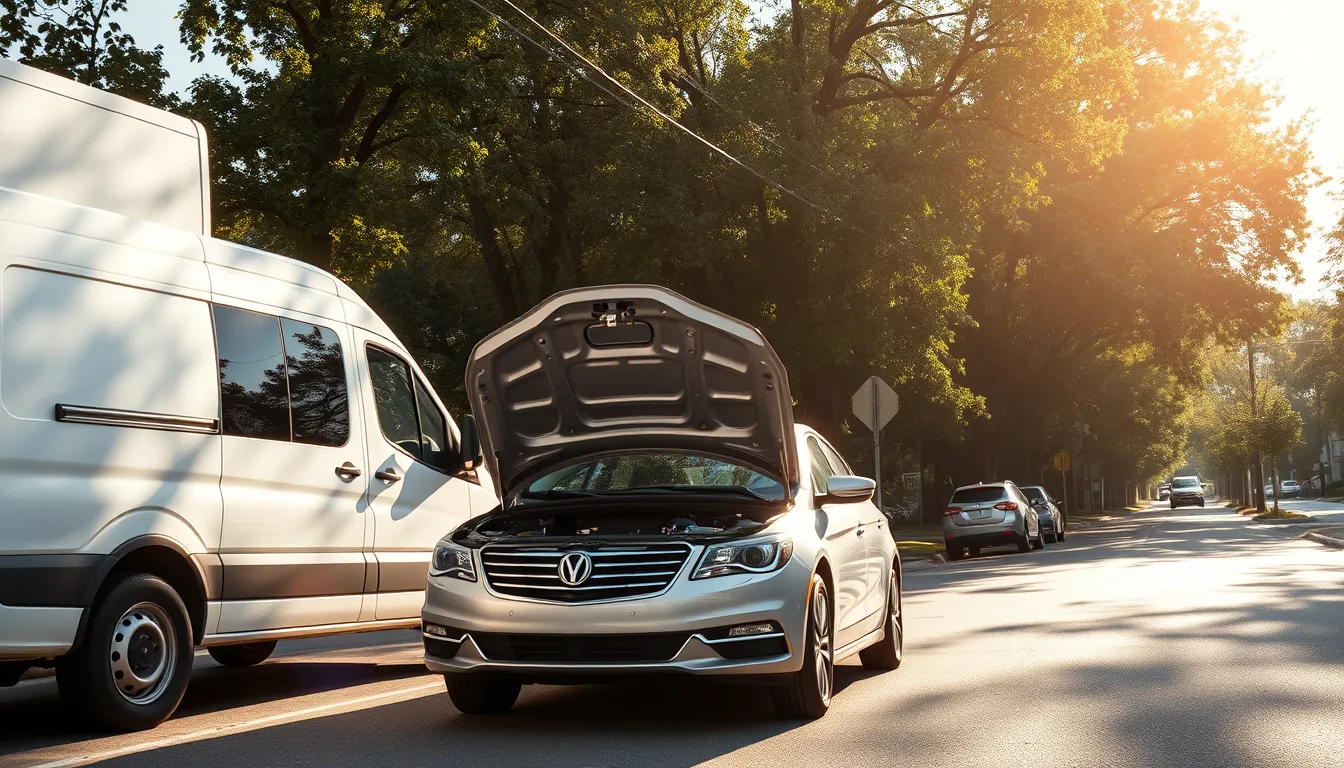
Mobile Mechanic in Atlanta
Your car does not need to be towed for a dead battery, a flat, a brake job or a no-start. A technician brings the tools and the parts to wherever it is parked.
- Same-day visits across Metro Atlanta
- Diagnostics, brakes, batteries, tires and diesel
- We come to your home, office, lot or roadside
Mon-Sun, 7am-10pm · Serving 30 miles of downtown Atlanta
What does a mobile mechanic in Atlanta actually do?
A mobile mechanic performs the repairs that do not require a lift or a paint booth, at the location where the vehicle already sits. That is the whole idea. Instead of paying for a tow, a rental, and two days of a shop holding the car, a technician arrives with hand tools, a diagnostic scanner, jacks, stands, and the parts for the most common failures.
The work that fits this model is broader than most people expect. Batteries, starters, alternators, brakes, brake lines, suspension components, belts, hoses, thermostats, water pumps, spark plugs, coils, fuel pumps accessible from the top, sensors, wiring faults, and most check-engine diagnostics are all done in a driveway every day. So are tires, which is why flat-tire calls are some of the most common we get.
What does not fit is anything needing a lift, a frame machine, a wheel alignment rack, or a paint booth. Transmissions, engine swaps, structural collision repair and most exhaust work under the vehicle fall outside what can be done on the ground safely. When a job lands there, the right answer is an honest conversation on the driveway, not a guess.
Atlanta adds its own reasons to want this. The city has a large population of apartment and townhome residents who park in shared decks and have no legal place to work on a car, no garage to store tools, and often no second vehicle to use while one sits at a shop. Traffic between the perimeter and downtown makes a shop drop-off a half-day event even when the repair itself is quick.
For a commuter whose car will not crank at 7am, the difference between a mobile visit and a tow is the difference between making a meeting and losing a day. That is the practical case for the service, and it is why the model has grown so quickly in cities with the density and traffic Atlanta has.
What we bring
Hand tools and torque wrench, floor jack and stands, a full diagnostic scanner with live data, battery tester and charger, tire plug and patch kit, common fluids, and a stock of the fast-moving parts for the vehicles we see most.
What we cannot do on site
Jobs needing a lift, alignment rack, frame work or paint. If your fault turns out to be one of those, we tell you on arrival and you keep the diagnosis.
What we bring to your driveway
Each of these is a full on-site visit with the tools, parts and diagnostic equipment the job needs. Pick the one closest to your problem, or just call and describe what the car is doing.
A quick word on what actually decides whether a job can be done in a parking spot: access from above, and whether the vehicle needs to be lifted for a component to come off. Anything reachable through the engine bay, the wheel arch, or from underneath with the car on stands in a flat lot is fair game. That covers more than most drivers assume, including most starters, alternators, water pumps, thermostats, brake calipers and rotors, and the fuel pump on any vehicle with an access panel under the rear seat.
What we will not do is pretend. If your fault needs transmission removal, a frame measurement, a wheel alignment rack or exhaust work welded under a lift, we say so plainly on the phone and save you the call-out fee.
Mobile mechanic service areas around Atlanta
We work out of Atlanta and travel roughly 30 miles from downtown. If you are inside the perimeter or in one of the close-in suburbs below, a visit is usually same-day.
- Sandy Springs, GA
- Marietta, GA
- Decatur, GA
- Alpharetta, GA
- Roswell, GA
- Smyrna, GA
- Brookhaven, GA
- Dunwoody, GA
- East Point, GA
- College Park, GA
Inside the perimeter versus the suburbs
Distance on a map means very little in Atlanta. Ten miles inside the perimeter at 5pm can take forty minutes, while twenty miles out on a reverse commute can take twenty-five. You get a two-hour arrival window instead of a single promised time, so you are not stuck waiting on a curb for an hour because the Downtown Connector locked up. A weekday afternoon slot in Brookhaven or Dunwoody is usually wider and easier to hold than the same slot in Midtown.
The city itself presents its own problems. Apartment decks on Peachtree, Lindbergh and the BeltLine corridor frequently have low clearance, tight turns and no legal place to leave a car on jacks for an hour. Condo associations in Midtown and Buckhead have rules about working on vehicles in shared garages. When a lot is genuinely unusable we say so before dispatch rather than arriving and turning around, and we can often perform the diagnosis at the curb or arrange for the vehicle to be moved somewhere workable.
The close-in suburbs are the opposite story. Sandy Springs, Smyrna, Marietta, Decatur and Dunwoody are mostly driveways and surface lots with room to work, which makes them the easiest visits in the metro. Alpharetta, Roswell and Brookhaven are similar, with the added wrinkle that many of those homes have sloped driveways where a jack needs a level patch of asphalt or a piece of plywood to sit safely.
Highway corridors we work most often
I-285 is the single most common place we are called to, because it carries the most traffic and has the least shoulder. The Perimeter's shoulders are narrow, and a car stopped on the outer loop near a merge point is genuinely dangerous. If you break down there, get out of the vehicle, get behind the barrier if there is one, and call before you try to do anything yourself.
I-20 west toward Six Flags and east toward Decatur, I-75 south toward the airport and north toward Marietta, and I-85 northeast toward Gwinnett all see their share of breakdowns. Downtown Connector stops are the hardest of all because there is nowhere safe to stand and nowhere safe to work. On those calls the answer is often a quick roadside fix on the shoulder — a jump, a tire, a fuel delivery — rather than a full repair, and we will tell you honestly which one you are getting.
What mobile mechanic service costs in Atlanta
Every job is quoted before work starts. These are the ranges we actually see, so you can decide whether the visit makes sense before you call.
Four things move a quote up or down. Vehicle type is the biggest: a battery on a four-cylinder sedan and a battery on a diesel pickup are different jobs with different part costs and different access. Part quality matters just as much, and we will always tell you when there is a cheaper and a better option rather than quietly fitting whichever one protects the margin. Access is the third, because a starter buried under an intake manifold and a starter with clear line of sight are not the same amount of labor even though the part number is identical. Location is the last, mostly for commercial calls where a dock or a yard in the middle of a shift costs more to service than a quiet driveway on a Saturday.
The diagnostic fee deserves a straight answer because people ask about it constantly. You are paying for the technician's time and for the scanner and the live data, and you are paying for it regardless of what comes back. What you are not paying for is a guess. If the fault turns out to need a shop, you keep the written finding and you are under no obligation to have us do anything further. That is the deal, and it is the same deal whether the diagnosis takes fifteen minutes or ninety.
| Job | Typical range |
|---|---|
| Service call and diagnostic | $95 – $150 |
| Battery replacement, installed | $180 – $280 |
| Starter or alternator replacement | $320 – $620 |
| Brake pads and rotors, one axle | $280 – $520 |
| Tire plug and patch, on site | $75 – $120 |
| Spare fitting and torque | $70 – $110 |
| Check-engine diagnosis with live data | $95 – $160 |
| Commercial truck tire service | Quoted per call |
Ranges reflect common Atlanta jobs and vary by vehicle, part quality and access. The full breakdown lives in the Atlanta mobile mechanic cost guide.
How it works, start to finish
- Call or send the requestTell us the vehicle, what it is doing, and exactly where it is parked. A photo of the engine bay or the tire helps but is not required.
- Get a window and a quoteWe confirm when a technician can be there and give you a range for the call-out plus the likely repair, so there is no surprise at the end.
- Meet the technicianThey inspect, run the scanner, and confirm the actual fault before touching anything. You approve the repair and the price before work starts.
- Repair on siteMost jobs finish in one visit. If a part has to be sourced, we tell you the timeline rather than leaving you guessing.
- Drive away or get a planIf it is fixed, you drive it. If it needs a shop, you get a written finding of what failed so the next visit is not a fishing trip.
Why people call us instead of towing
A tow in Atlanta typically costs $125 to $250 for a short local run, and that is before the shop has looked at the car. Add a diagnostic fee, a day or two without the vehicle, and often a rental, and the real cost of "just towing it" is far more than the tow itself.
For a dead battery, a flat, a brake job, a starter or a sensor fault, none of that is necessary. The repair is the same repair whether it happens in a bay or in your parking spot. The only thing that changes is who travels.
There is also the question of what happens in the shop queue. A mobile visit is usually scheduled at a specific window. A shop drop-off often means leaving the car for a day and hoping it makes the afternoon list. For anyone with a work schedule, that difference matters more than the labor rate.
The honest exception is the job that genuinely needs a lift. We would rather tell you that on the phone than take a call-out fee to confirm what a two-minute conversation could have settled.
A/C and electrical faults in Atlanta heat
Atlanta summers push a car's cooling and electrical systems harder than most of the country. A/C compressors, condensers, blower motors and refrigerant leaks are a large share of the calls we get between May and September. So are batteries, which fail more often in sustained heat than in cold, even though cold is when drivers notice them.
A car that will not cool is often a low refrigerant charge rather than a failed compressor, and that is diagnosable on site with manifold gauges. A compressor replacement is a bigger job but still fits the mobile model on most vehicles, since it is accessible from the top or through the wheel well.
Heat also accelerates wear on belts, hoses and coolant. A coolant leak that would be a slow drip in a milder climate becomes a stranded car on I-285 in July. If the temperature gauge has started moving where it used to sit still, that is worth a visit before it becomes a head gasket.
Brakes and suspension on Atlanta roads
Atlanta's street surfaces vary enormously between freshly paved suburban arterials and older city streets with potholes, patched utility cuts and heavy truck traffic. That mix is hard on suspension components. Worn bushings, failing struts and bent control arms show up as clunks, uneven tire wear and a pull that was not there before.
Brakes wear faster here too, partly from traffic. A car that spends its life in stop-and-go on the Downtown Connector uses pads at a rate a rural car never will. Grinding, a soft pedal, or a vibration through the wheel under braking are all worth checking before they become a rotor replacement instead of a pad replacement.
What each of those symptoms usually means is worth knowing before you call. A high-pitched squeal that starts when the pads are cold is the wear indicator touching the rotor, and it means you have a few hundred miles left. Grinding that never stops means the pad material is gone and the backing plate is cutting into the rotor, which turns a pad job into pads and rotors on both sides of the axle. A soft or spongy pedal points at air in the hydraulic system or a failing master cylinder rather than the pads, and that is a different repair entirely. A vibration through the wheel under braking is usually a warped or unevenly worn rotor, and a pull to one side under braking often means a sticking caliper.
The suspension side is where Atlanta's road surfaces really show. Potholes and patched utility cuts on older city streets like Moreland, Ponce de Leon and the surface streets around West End punish struts, control arm bushings and sway bar links. A clunk over bumps that was not there a year ago, wandering steering, or cupping on the inner edge of a front tire are all worth a look before a worn bushing becomes a worn tire and a worn tire becomes an alignment you did not budget for.
What breaks on Atlanta cars, month by month
Atlanta does not have four hard seasons, but the failure pattern across a year is still predictable enough to plan around. Knowing what tends to go wrong when will not stop the failure, but it does give you a chance to deal with it on your terms rather than on the shoulder of I-285.
March through June: cooling and A/C
The first eighty-degree week is when air conditioning calls begin, and they peak in July. The most common finding is not a dead compressor but a slow refrigerant leak at a Schrader valve, an O-ring or a condenser fitting. A system that blew cold last September and blows warm in May has almost certainly lost charge over the winter rather than failed suddenly. That is a diagnosis job, not a parts job, and it is worth doing before August, when every shop in the metro is backed up and the wait for an appointment is measured in days.
Radiator hoses and coolant reservoirs age out on the same schedule. A coolant smell with no visible puddle, or a reservoir that needs topping up every couple of weeks, is a leak that will find a way to strand you at the worst moment. Atlanta's summer heat turns a small coolant loss into a warped head within minutes once the gauge starts climbing.
July through September: batteries and belts
Batteries fail in heat far more often than in cold, even though the symptoms only appear when the first cold morning arrives. Sustained ninety-degree heat accelerates the internal corrosion that kills a battery, and a three-year-old battery that spent two summers in Atlanta traffic is on borrowed time. A free load test takes about ninety seconds and tells you where it stands before it leaves you somewhere inconvenient.
Serpentine belts crack and glaze in the same window. A belt that squeals on a cold start in the morning and settles down once warm is telling you it is due, and a snapped belt takes the water pump and often the alternator with it. That is a fifteen-minute replacement or a two-hundred-mile tow, depending on where it lets go.
October through February: brakes and starting
Brake work clusters in the fall because that is when most drivers notice the change after a summer of stop-and-go. Pads worn down through the summer heat announce themselves with a squeal or a light on the dash around October. Getting to them at the squeal stage keeps the job in the four-hundred-dollar range rather than the eight-hundred-dollar range that follows a rotor replacement on both axles.
Starting problems show up in the same months for a different reason. A battery already weakened by summer heat meets its first genuinely cold morning and simply does not have the cranking amps left. A slow, labored crank on the first cold day of the year is the clearest warning you will get, and it usually comes with a few days of warning before a no-start.
Year round: tires and potholes
Atlanta's road surfaces are hard on tires all twelve months. Heat in summer softens the rubber and accelerates wear on the shoulders, while winter rain and the freeze-thaw cycle open the potholes that bend wheels and split sidewalls. A tire losing a few PSI a week is not normal and usually means a slow leak at a valve stem, a bead or a nail the tread is holding. Left alone, a slow leak becomes the call we get most often: a flat on the interstate with the driver already late for something.
Fleet and commercial truck support
Atlanta is a freight city. I-20, I-75, I-85 and I-285 all converge here, and the warehouse corridor south of the city and around the airport runs on box trucks, sprinters and trailers that cannot afford a day down.
Mobile service fits fleet work unusually well because the vehicles are already parked in a yard or at a dock. A technician can work through several units in a morning without anything being driven anywhere. Tire pressure checks, tread inspection, brake inspection, battery testing and fault-code scans on a schedule catch the failures that would otherwise happen at the worst possible moment on the interstate.
Commercial tire service is the other half of it. A semi with a blown steer tire on I-285 at 2am is not a tow-truck problem, it is a tire technician problem, and the difference in downtime is measured in hours. We handle semi, trailer and box-truck tire service at docks, yards and on the shoulder.
If you run a small fleet and want a standing arrangement rather than one-off calls, say so when you call. Scheduled yard service usually costs less per unit than emergency call-outs, and the vehicles stay in service.
Questions to ask before you book
Any mobile mechanic should be able to answer these without hesitation. If they cannot, that is your answer.
- What is the call-out fee, and is it credited toward the repair? Some apply it, some do not. Ask before they drive out.
- Are parts included or separate? A quote that hides parts is not a quote.
- What happens if it cannot be fixed on site? You should not pay twice for the same diagnosis.
- Is the technician insured? A mobile mechanic working on your property should carry liability coverage.
- Do you warranty the labor? A short labor warranty is standard. Lifetime promises on a driveway repair are not credible.
- Can you show the old part? A reputable technician has no problem with this.
One rule that saves money
Describe the symptom, not the diagnosis. "It cranks but will not start" gets a better result than "I think it needs a fuel pump," because the second one anchors the visit to a guess.
Frequently asked questions
Do you come to my house or do I have to tow the car?
We come to the car. Most no-start, battery, brake, tire and diagnostic jobs are done at your home, apartment lot, office garage or the shoulder. If the fault turns out to need a lift, we tell you before anything is touched and you decide whether to tow.
What areas of Atlanta do you cover?
We cover the City of Atlanta and the surrounding Metro area within about 30 miles of downtown, including Sandy Springs, Marietta, Decatur, Alpharetta, Roswell, Smyrna, Brookhaven, Dunwoody, East Point and College Park.
How fast can someone get to me?
Same-day visits are normal when you call before mid-afternoon. Emergency and no-start calls are prioritized. We confirm a window when you call rather than promising a time we cannot keep.
What does a mobile mechanic cost in Atlanta?
You pay a service call plus labor and parts. Most diagnostic visits land between $95 and $150 for the call-out and diagnosis, then labor for the repair. A battery replacement installed usually runs $180 to $280 depending on the vehicle. We quote before we start.
Can you work on a car in a parking garage?
Yes, within limits. We work in garages with enough headroom and ventilation, and we never run an engine inside an enclosed structure. If the job needs exhaust or a lift, we say so on arrival.
Do you handle work trucks, vans and diesel?
Yes. Diesel diagnostics, DEF and emissions faults, fuel system work and commercial tire service for box trucks, trailers and semis are part of what we do, including dock and yard visits.
Are the parts included in the quote?
Parts are quoted separately so you can see the cost. If you supply your own part we will fit it, though we cannot warranty a part we did not source.
What if the problem cannot be fixed on site?
You get a written finding of what failed and what it needs. You are under no obligation to use us for the repair, and you can take the diagnosis to any shop.
Car will not start? Call now.
Tell us where the vehicle is and what it is doing. We will tell you honestly whether it is a mobile job or one that needs a shop.